
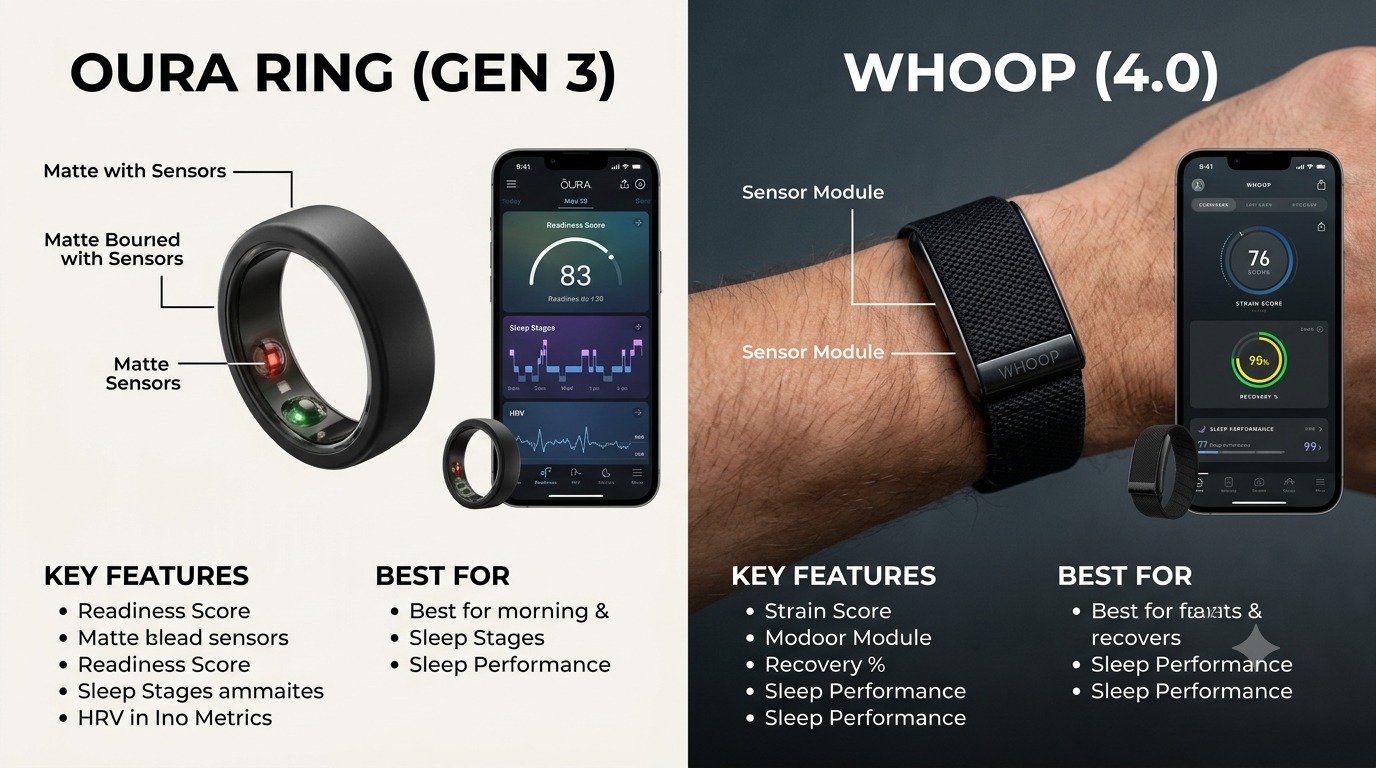
PART 1: Competitive Pattern & Intent Analysis
1. The Shared Pattern (Baseline Minimum Viable Content)
An analysis of the top-ranking results reveals a consistent baseline structure:
- Form Factor & Design: Finger-based titanium ring vs. screenless wrist/body band.
- Sleep & Recovery Metrics: Comparing Oura’s Readiness/Sleep scores against WHOOP’s Strain/Recovery percentage.
- Exercise Tracking: Comparing basic daily movement tracking against granular cardio/strength strain tracking.
- Pricing Models: Upfront hardware cost + low subscription (Oura) vs. zero upfront cost + high recurring subscription (WHOOP).
- Battery Life & Charging: Ring dock charging vs. WHOOP’s battery pack.
2. The Content Gap Opportunity
While existing articles cover basic specifications, they fail to provide practical insight into three key areas:
- The 3-Year True Cost Tipping Point: Most reviews state prices without calculating the exact point where WHOOP becomes more expensive than Oura.
- Barbell & Strength Training Limitations: Standard reviews ignore how wearing a metal ring during heavy barbell work or kettlebell sessions causes pinching and scratching, whereas WHOOP’s bicep band offers uninterrupted data collection.
- Algorithmic Philosophy: Reviews treat both devices as direct competitors, missing the core strategic difference: Oura is descriptive (tells you how your body responded to life), while WHOOP is prescriptive (tells you exactly how hard to train today).
3. Primary User Intent & Tone
- Buyer’s Intent: Late-stage consideration. Searchers understand what both devices do; they are looking for a clear decision framework before making a purchase.
- Tone & Style: Analytical, direct, and authoritative. Avoid generic introductions. Focus on real-world practicalities, long-term costs, and specific use cases.
PART 2: The Definitive SEO Blog Post
Oura Ring vs WHOOP: Which Biohacking Wearable Wins?
The debate between the Oura Ring vs WHOOP comes down to one fundamental question: Are you trying to optimize your overall health and sleep, or are you trying to manage daily athletic strain?
Both screenless wearables track heart rate variability (HRV), resting heart rate, sleep stages, and body temperature. However, they translate that data into completely different lifestyles.
This breakdown compares their accuracy, battery performance, real-world usability, and long-term costs to help you choose the right device.
Oura Ring vs WHOOP: Strategic Summary
| Feature | Oura Ring (Gen 4) | WHOOP (4.0/5.0) |
| Primary Focus | Sleep, Readiness, Wellness | Strain, Recovery, Athletic Performance |
| Form Factor | Titanium Ring (Finger) | Fabric Band (Wrist/Bicep/Apparel) |
| Data Philosophy | Descriptive (Shows trends) | Prescriptive (Recommends targets) |
| Strength Training | Poor (Pinches on barbells) | Excellent (Bicep band option) |
| Upfront Cost | From $349 | $0 (Hardware included) |
| Subscription Fee | ~$5.99/month | ~$20–$30/month |
1. Form Factor and Daily Comfort
The physical design of these devices shapes how you interact with them daily.
The Oura Ring sits on your finger. Because blood flow in digital arteries is closer to the surface, ring sensors deliver high signal quality for resting overnight biometrics. It looks like standard jewelry, making it easy to wear in formal or professional settings.
                Biometric Sensor Location & Signal Profile

     Oura Ring (Finger)                   WHOOP (Wrist / Bicep)
  ┌─────────────────────────┐          ┌─────────────────────────┐
  │ Digital Arteries        │          │ Radial Artery / Micro   │
  │ • Shallow depth         │          │ • Susceptible to motion │
  │ • High overnight accuracy│          │ • Bicep placement fixes │
  │ • Friction with weights │          │   motion artifacts      │
  └─────────────────────────┘          └─────────────────────────┘
WHOOP uses a fabric wristband. While it looks like a traditional fitness tracker, you can move the sensor to a bicep band or dedicated athletic clothing.
For weightlifting, kettlebell training, or rowing, the WHOOP bicep placement is far more practical. Wearing a metal Oura ring during heavy barbell work causes uncomfortable friction and scratches the titanium finish.
2. Algorithmic Philosophy: Readiness vs. Strain
Understanding the Oura Ring vs WHOOP dynamic requires looking at how each platform processes your data.
  OURA: DESCRIPTIVE MODEL
  [Sleep Data + HRV] ──► Daily Readiness Score ──► User Interprets Action

  WHOOP: PRESCRIPTIVE MODEL
  [Previous Strain + Sleep] ──► Target Strain Score ──► App Dictates Action
Oura’s Readiness Approach
Oura frames your daily metrics through a Readiness Score (0–100). It evaluates your sleep efficiency, body temperature, resting heart rate, and long-term HRV trends.
If you are fighting off an infection or experiencing elevated stress, Oura prompts you to activate Rest Mode. It acts as a passive health monitor that lets you adjust your own schedule.
WHOOP’s Strain Engine
WHOOP operates on a Strain vs. Recovery scale. Using continuous cardiovascular monitoring, WHOOP assigns a Strain score from 0 to 21 based on your exertion throughout the day.
It calculates your nightly Sleep Need based on accumulated strain. If your recovery score is high, WHOOP tells you to push harder. If your recovery score is in the red, it advises taking a rest day.
3. Battery Life and Charging Mechanics
Battery performance differs significantly in practice.
Oura lasts between 4 and 7 days on a single charge. Recharging requires placing the ring on a desktop charging puck for roughly 80 minutes. Most users top it off while showering.
WHOOP lasts roughly 4 to 5 days, but uses a slip-on battery pack. You slide the charged power bank directly onto the strap while wearing it. This allows for 100% continuous data collection without removing the device.
4. Total Cost of Ownership Analysis
Comparing the price of the Oura Ring vs WHOOP requires looking beyond year one.
            3-Year Cumulative Cost Comparison

  $800 ┬────────────────────────────────────────────── WHOOP ($717)
  $700 ┤                                              ╱
  $600 ┤                                  ┌─────────── (Tipping Point)
  $500 ┤                     ┌────────────┴─────────── OURA ($558)
  $400 ┤  ┌──────────────────┘
  $300 ┼──┘
       └─────── Year 1 ──────────── Year 2 ──────────── Year 3 ───────
- Year 1: WHOOP is cheaper upfront because the hardware is included with the $239–$300 annual membership. Oura requires buying the ring ($349 base) plus a $69.99 annual subscription, totaling ~$419.
- Year 2: Costs align as WHOOP’s higher recurring subscription fee catches up.
- Year 3: Oura becomes significantly cheaper over time. By month 36, WHOOP totals ~$717, whereas Oura totals ~$558.
The Verdict: Which Wearable Should You Buy?
Choose the Oura Ring if your primary goal is sleep tracking, lifestyle monitoring, and a subtle design that looks like standard jewelry. It provides clear health insights without forcing daily workout targets.
Choose WHOOP if you follow a structured training program, lift weights regularly, and want an actionable recovery score to guide your exercise intensity.
Ready to optimize your recovery? Check current pricing and hardware configurations using our direct link below:
[Claim Your Biohacking Gear Discount Here]